Debunking Myths About LASIK and Eligibility for Government Jobs
The truth is very different. Modern LASIK is safe, advanced and widely accepted across several government job categories when you meet the required vision requirements. Many of the fears you hear are old laser vision correction myths that do not match today’s standards for Government job rules.
This guide by our experts LASIK surgery in Santacruz at Kenia Eye Hospital will help you understand LASIK eligibility, clear common LASIK surgery myths, and make an informed, confident decision for your future.
10 Common Myths About LASIK and Government Jobs And The Truth Behind Them
Before you worry about rejection or restrictions, it’s important to know which LASIK concerns are real and which are just rumours. Below are the real facts behind the most common LASIK Surgery Myths:
1. Myth: LASIK is Completely Banned for all Government Jobs
Truth: There is no universal ban. Many civil, clerical, and administrative roles accept candidates after LASIK if the eyes meet basic LASIK eligibility, vision requirements, and retinal checks. Boards usually look for healthy corneas and stable vision. This is why understanding Government job rules is essential.
2. Myth: You Cannot Clear UPSC, SSC, or State Exams After LASIK
Truth: Most administrative services focus on corrected visual standards. Many candidates qualify for UPSC, IRS, IFS, and other roles after LASIK, provided they meet 6/6 vision criteria and have no retinal issues. Myths rise because older candidates confuse older medical forms with current LASIK for government exams expectations.
3. Myth: Railways, Police, CAPF, or Paramilitary Always Reject LASIK
Truth: Different departments follow different rules. Some safety sensitive technical roles have strict refractive surgery eligibility, especially for driving or signalling duties. Others accept LASIK if reports are clean. Always check the latest notifications for LASIK and Railways, LASIK and Police forces, CAPF eligibility, or paramilitary LASIK acceptance.
4. Myth: Defence Services Never Accept Candidates Who Had LASIK
Truth: Defence services now follow more detailed eyesight rules instead of one simple “yes” or “no” to LASIK. Some ground and non-flying posts may accept candidates after LASIK if the surgery was done after a certain age, the power was within limits, the cornea is strong, and the retina is healthy.
At the same time, many flying roles, submarine or diving duties, special forces and a few entry routes still prefer natural eyesight and may not accept any laser vision correction. Because these rules are updated from time to time, every aspirant should always check the latest official notification for their exam and discuss it with an eye specialist before deciding on surgery.
5. Myth: Medical Boards Cannot Detect Surgery, So Hiding LASIK is Safer
Truth: Hiding surgery increases your risk of medical disqualification. Boards use slit lamps to check the cornea. A simple slit lamp assessment can reveal previous laser treatment. They can also check for flap edges, dryness, or corneal irregularities. Always make clear medical history disclosure, and keep all eligibility documentation handy.
6. Myth: LASIK Always Causes Problems That Lead to Rejection
Truth: With correct pre screening and proper aftercare the chance of serious LASIK complications is low. Boards look at actual results: clear cornea, good retina, stable refraction, and strong night performance. This includes evaluation of night vision requirements, colour vision test, night blindness disqualification, and field vision requirements.
7. Myth: You Can Undergo LASIK Just Before Your Medical Exam
Truth: Healing takes time. Many Government departments want stable eyes for months. This is why candidates must respect the six month recovery guideline, any medical test waiting period, and common timelines for post-LASIK recovery. Avoid late procedures that risk freshly operated exclusion.
8. Myth: All Laser Procedures Are Treated The Same
Truth: Not all eye procedures are the same. Flapless LASIK, Trans PRK, SMILE, ICL and lens implants heal differently and change the cornea in different ways. Some government roles prefer surface procedures like Trans PRK, while others accept LASIK or SMILE if the cornea stays strong. Most confusion happens because people assume every laser surgery is treated the same, which is not true.
9. Myth: Rules Never Change
Truth: The rules keep changing. Every year, different departments update their eyesight standards and medical instructions. So you must always check the latest government notifications, recruitment ads and medical guidelines instead of trusting rumours from coaching groups or old videos. Only official documents tell you the correct LASIK rules for your exam.
10. Myth: LASIK Automatically Guarantees Eligibility
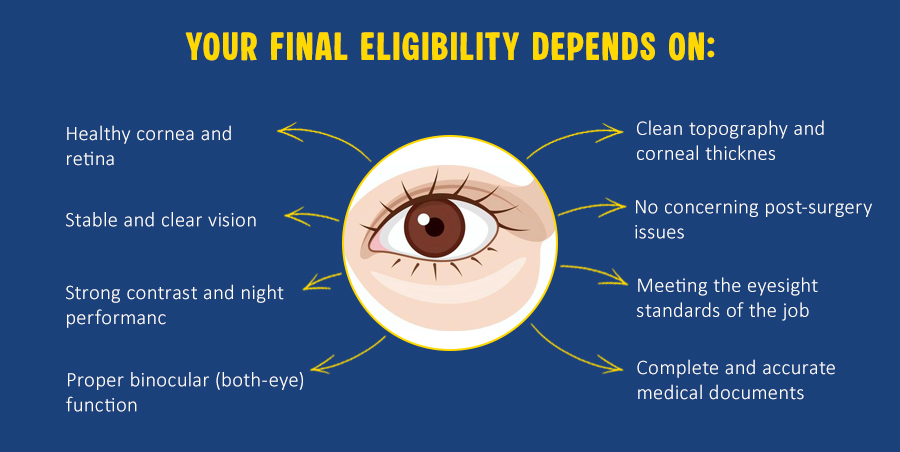
Truth: Your eligibility depends on the actual health of your eyes. Medical boards check if your retina is healthy, your cornea is strong, your vision is clear, and you meet the eyesight standards for the role you applied for. They also rule out issues like high myopia or retinal problems. This is why every candidate needs a personal evaluation by an experienced eye surgeon, not general advice.
When you look at the Key Realities about LASIK and Government Jobs, it becomes clear that most fears come from misinformation. What truly matters is updated guidelines and your individual eye condition.
Why LASIK Allowed In Government Jobs Depends On Procedure, Timing, And Eye Health
Government medical rounds look at function, safety, and stability. They check the cornea, retina, and post-surgery clarity. They also consider tasks like driving, flying, shooting, screen-based work, physical endurance, and technical responsibilities. Medical boards follow Government service standards, high-risk job vision rules, and specific manuals such as the Indian Railways Medical Manual and Indian Army vision rules.
Planning LASIK Safely As A Government Job Aspirant
Follow these steps:
- Check the vision guidelines of your targeted role.
- Confirm whether it is a non-safety-sensitive role or heavy-duty technical post.
- Understand Permanent eligibility rules and application rejection rates.
- Get full scans: topography, pachymetry, retinal OCT, and tear evaluation.
- Discuss vision correction alternatives, including ICL, SMILE, and Trans PRK.
- Plan surgery 6-12 months before any medical exam.
- Prepare for follow-ups and keep reports ready
- Align decisions with reliable application guidelines from official sources.
This approach protects your career and eye health while reducing future risk.
Consult the Best LASIK Surgeon in Mumbai to Discuss the Right Procedure for Your Government Career!
If you are searching for lasik eye surgery near me , you need accurate advice before surgery and clear guidance on how LASIK affects government medical exams. Kenia Eye Hospital offers both, providing detailed testing, counselling and transparent communication for every aspirant.
Why aspirants choose Kenia Eye Hospital in Santacruz, Mumbai
- NABH-accredited and ISO 9001-certified centre with advanced diagnostics.
- Experienced surgeons familiar with medical exam counselling for aspirants.
- Full range of options: LASIK, flapless LASIK, SMILE, Trans PRK, ICL, and IOL.
- Ability to align surgery with your exam schedule and medical round requirements.
- Guidance for LASIK in central government, state jobs, and technical roles.
- Clear assessment of aided vs unaided vision, visual aids acceptance, and pre-screening for safe outcomes.
Candidates preparing for government jobs who search for best lasik eye surgery in Mumbai can rely on Kenia Eye Hospital for precise evaluation and responsible, expert guidance.
Book Your Evaluation for lasik surgery in Mumbai at Kenia Eye Hospital Today!
Call or WhatsApp: +91 75064 99962
Address:1st Floor, Rizvi Nagar, Near Sarang Restaurant S.V. Road corner, Santacruz (W), Mumbai 400054
FAQs
Can the medical board reject me if I have dry eyes after LASIK?
Yes, even mild dryness can affect clarity and comfort during medical tests. You must complete healing and show normal tear function before your medical exam.
Do government doctors ask for pre-LASIK and post-LASIK reports during verification?
Many boards do. They may request old prescriptions, topography, pachymetry, surgeon notes, and post-op stability reports. Keeping all documents ready helps avoid confusion.
Will I fail my medical if my corneal thickness is borderline after LASIK?
If pachymetry shows thin corneas or irregular scans, some departments may consider it unsafe for high-risk roles. A specialist must check your scans before you apply.
Is it safer to choose SMILE instead of LASIK if I want to apply for defence roles?
Not always, no single procedure guarantees eligibility. Different jobs evaluate the eye’s final condition, not just the surgery type. Your surgeon must decide the safest option for your eyes.
Can I appear for PET (Physical Efficiency Test) soon after LASIK?
No, you must avoid heavy running, sweating, and physical strain for several weeks. Most candidates wait months before PET so that the cornea is fully stable and the vision is steady.